
Rock Climbing Grades Explained (V-Scale, YDS, and French)
If you've ever stood at the base of a route and wondered what "5.10a" or "V3" actually means — you're not alone. Climbing grades can feel like a secret language. At Stone Climbing, we want every person who walks through our doors to feel confident on the wall. So here's your complete, no-fluff guide to understanding climbing grades.
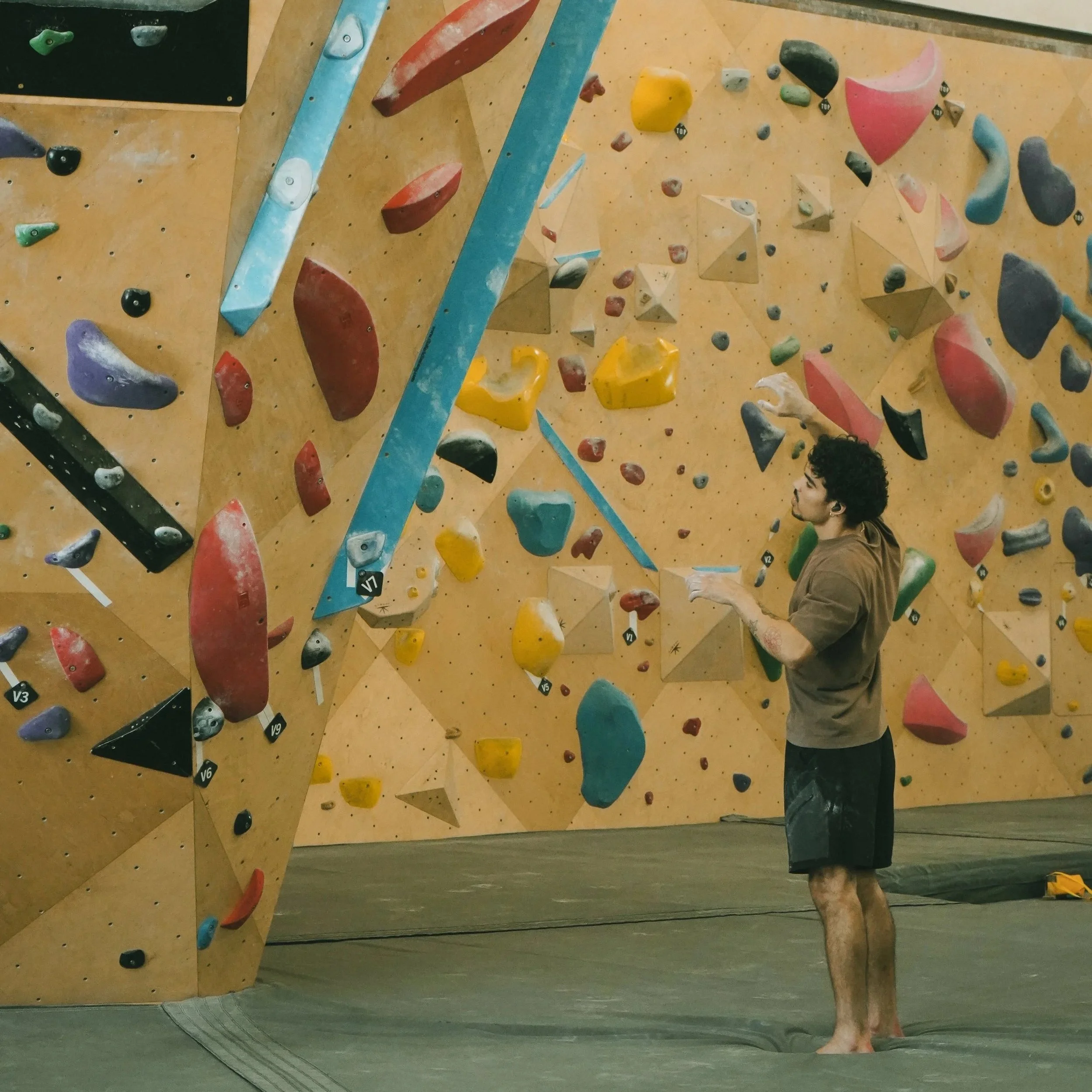
Why Do Climbing Grades Exist?
Grades exist to give climbers a rough idea of how difficult a route or problem is before they try it. Think of them like trail difficulty ratings for hikers — they help you set expectations, choose appropriate challenges, and track your progress over time.
The key word is rough. Grades are subjective. They're set by humans, influenced by body type and style, and can vary from gym to gym and crag to crag. A "soft" V4 at one gym might feel like a "hard" V5 somewhere else. Don't treat grades as gospel — treat them as a starting point.
That said, understanding the systems will make you a smarter, more confident climber.
The Three Most Common Grading Systems
1. The V-Scale (Hueco Scale) — Bouldering
The V-Scale is the standard grading system for bouldering in the United States. It was developed by legendary climber John Sherman (nicknamed "Vermin") at Hueco Tanks, Texas, in the late 1980s — hence the "V” for Vermin.
The scale runs from VB (Beginner) through V17, with V17 representing the current ceiling of human climbing performance. Most recreational climbers spend the majority of their climbing life in the V0–V6 range, and that's perfectly normal.
Here's what the grades roughly feel like:
VB / V0 — The very beginning. Big holds, straightforward movement. If you're visiting Stone Climbing for the first time, start here.
V1–V2 — Still beginner-friendly, but requiring a bit more body positioning and footwork awareness.
V3–V4 — Intermediate territory. Moves are more technical, holds get worse, and you'll start needing real technique and strength.
V5–V6 — Solid intermediate to advanced. Requires strength, flexibility, and problem-solving.
V7–V9 — Serious climbing. Most people at this level have been climbing consistently for years.
V10+ — Elite. Less than 1% of climbers reach this level.
One important note: there is no V18 or higher (yet). The V-Scale is open-ended, but grades above V17 haven't been established by consensus. Maybe you can be the first.
2. The Yosemite Decimal System (YDS) — Rope Climbing
The Yosemite Decimal System is used in the United States for graded rope routes — both top-rope and lead climbing. You'll see it written as numbers like 5.7, 5.10a, 5.12c.
The system originated in the Yosemite Valley in the 1950s. The "5" at the beginning indicates technical climbing requiring a rope — it's a holdover from the original classification that ran from Class 1 (walking) to Class 5 (technical climbing). For our purposes, every climbing route starts with 5.
The scale runs from 5.0 to 5.15d. Once the system reached 5.10, it became necessary to add letter subdivisions — a, b, c, d — to distinguish difficulty more precisely. So you'll see:
5.0–5.6 — Very beginner. Large holds, gentle angles. Great for absolute first-timers on the rope.
5.7–5.9 — Beginner to intermediate. Moves become more deliberate. Good footwork starts to matter.
5.10a–5.10d — The famous "5.10 wall" that many climbers spend months and even years working through. Technique and efficiency is greater than strength.
5.11a–5.11d — Advanced intermediate. Requires real climbing fitness and refined technique.
5.12a–5.12d — Advanced. Consistent training, strong fingers, and good movement are prerequisites.
5.13a–5.13d — Expert. Very few recreational climbers reach this level.
5.14a–5.15d — Elite and world-class. These are the routes that make international climbing news.
At Stone Climbing Jacksonville, our lead walls top out at 50 feet, giving you the full experience of working YDS routes at height.
3. The French System — Sport Climbing (International)
If you follow climbing media, read route guidebooks for European crags, or watch World Cup competitions, you'll encounter the French grading system. It's the international standard for sport climbing and is widely used outside North America.
French grades use a number followed by a letter (a, b, or c), sometimes with a "+" to indicate the harder end of that grade band. For example: 6a, 6b+, 7a, 8c+.
The scale runs from 1 through 9c, with 9c representing the current pinnacle of sport climbing (achieved only a handful of times in history).
It doesn't map perfectly onto YDS, but here's a rough comparison:
5 / 5+ ≈ 5.8–5.9
6a / 6a+ ≈ 5.10a–5.10b
6b / 6b+ ≈ 5.10c–5.10d
6c / 6c+ ≈ 5.11a–5.11b
7a / 7a+ ≈ 5.11c–5.12a
7b / 7b+ ≈ 5.12b–5.12c
8a ≈ 5.13b
9a ≈ 5.14d
You won't see French grades on our walls at Stone Climbing — we use YDS and V-Scale like most American gyms. But knowing the French system helps when you're watching competitions, reading international guidebooks, or planning that trip to Europe someday.